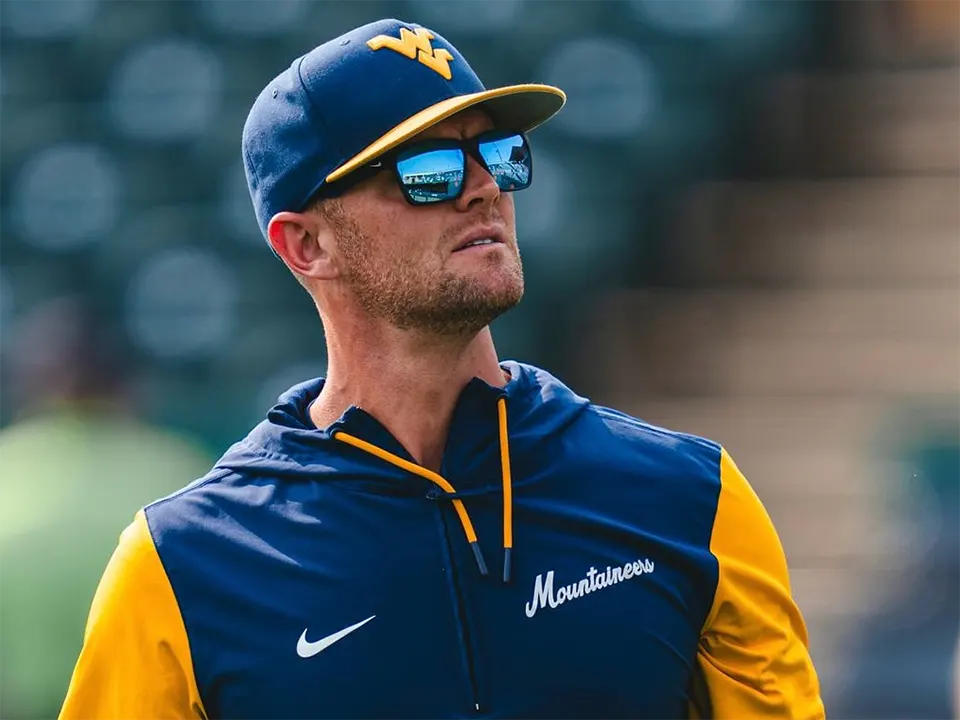
Steve Sabins is an American college baseball coach and former collegiate player. He is best known as the head coach of the West Virginia University baseball program. By 2026, Sabins had become one of the most important young coaching figures in NCAA baseball. His rise came through years of recruiting work, player development, and steady success inside the Big 12 Conference.
Sabins took over as the 20th head coach in West Virginia baseball history in June 2024. His promotion followed nearly a decade on the Mountaineers’ staff. In his first season as head coach in 2025, he led WVU to a 44-16 record, a Big 12 regular-season title, and another NCAA Super Regional appearance.
| Net Worth: | $3 Million |
|---|---|
| Real Name: | Steve Sabins |
| Birth Date: | May 11, 1987 |
| Age (as of 2026): | 39 Years |
| Birth Place: | Fort Worth, Texas, USA |
| Height: | 1.88 m (6 ft 2 in) |
| Parents: | Gary and Linda Sabins |
| Wife: | Tabitha Sabins |
Early Life
Steve Sabins was born on 11th May, 1987, in Fort Worth, Texas. He grew up in Austin, Texas, which WVU lists as his hometown. Baseball became a central part of his life from a young age. During his school years, he developed as an infielder and built the competitive habits that later shaped his coaching career.
Sabins attended Westwood High School in Austin, where he played under coach Bart Bratcher. He earned team MVP honors as a junior and senior. He also received academic all-district recognition, showing early balance between athletics and classroom work.
Family & Education
Steve Sabins was born to Gary Sabins and Linda Sabins. Public records from his college playing bio identify his parents by name. However, he has kept most details about his family background private.
Sabins has built his public identity around baseball rather than personal publicity. His career path reflects a strong support system, discipline, and long-term commitment to the sport. He has not shared many private family details in major public interviews.
Sabins attended Embry-Riddle Aeronautical University and graduated in 2011 with a bachelor’s degree in business administration. Before that, he played at Angelina College, Daytona State College, and Oklahoma State.
He later earned a Master of Science degree in educational leadership and higher education from Oklahoma State in 2013. His academic background became useful in coaching because it connected leadership, player growth, and team culture.
Career
Steve Sabins began his college playing career at Angelina College in 2007. He hit .307 and recorded 20 stolen bases during his freshman season. In 2008, he played at Daytona State College, where he hit .340, led the team in home runs, and earned team MVP honors.
He redshirted at Oklahoma State in 2009 before transferring to Embry-Riddle. At Embry-Riddle, he became a standout player. In 2010, he hit .347 with 11 home runs, 52 RBIs, and 21 stolen bases. He later earned Sun Conference Player of the Year and NAIA All-American honors. Steve Sabins moved into coaching soon after his playing career.
He served as head coach of the Leesburg Thunder in 2011 and led the team to regular-season and World Series titles. In 2012, he coached the Winchester Royals in the Valley Baseball League. His college coaching career began at Oklahoma State, where he worked as a graduate assistant from 2012 to 2013.
He later served as player development coordinator in 2014 and volunteer assistant in 2015. His duties included video analysis, scouting reports, recruiting, player feedback, and team development work. Steve Sabins joined West Virginia in 2016 as an assistant coach. He became recruiting coordinator in 2018 and associate head coach in 2022.
His work helped WVU attract some of the highest-ranked recruiting classes in program history. West Virginia promoted him to head coach in June 2024. His first season in charge became historic. In 2025, WVU won the Big 12 regular-season title outright, finished 44-16, and reached the NCAA Super Regionals.
He also earned ABCA East Region Coach of the Year honors. By June 2026, Sabins remained a central figure in WVU baseball’s rise. The Mountaineers continued competing on the national stage, and his leadership helped keep the program relevant in postseason conversations.
Personal Life
Steve Sabins is married to his wife, Tabitha. The couple has two children, Charlee and Tucker. Sabins appears to live a family-focused life while managing the demands of Division I baseball. His public image centers on coaching, recruiting, player development, and building a strong team culture. He has not publicly shared many details about hobbies, luxury purchases, or private lifestyle choices.
Social Media
Steve Sabins has a public X account under the handle @stevesabins. WVU also links to that account from his official coaching profile. He uses social media mainly for baseball-related content, team updates, recruiting messages, and WVU program promotion.
There is no widely verified public Instagram or Facebook account clearly promoted as his main personal platform. Most of his public visibility comes through WVU Athletics, press conferences, interviews, and team media coverage.
Steve Sabins Net Worth and Earnings
West Virginia University head baseball coach Steve Sabins has a base salary of $500,000 per year. His total compensation for the 2026 season reaches $550,000 when supplemental pay is included. Sabins signed a six-year contract extension that runs through the 2031 season, making him the highest-paid baseball coach in West Virginia program history.
Under the agreement, Sabins’ base salary remains at $500,000 annually, while his supplemental pay increases by $25,000 each year. His projected total compensation is $550,000 in 2026, $575,000 in 2027, $600,000 in 2028, and $625,000 in 2029. The deal also includes performance bonuses tied to team achievements and postseason success.
Sabins can earn $100,000 if West Virginia wins a national championship. He can also receive $30,000 for winning the Big 12 Tournament, $30,000 for a Big 12 regular-season title, and $25,000 for leading the Mountaineers to an NCAA Regional berth. These incentives give him additional earning potential beyond his guaranteed annual compensation.